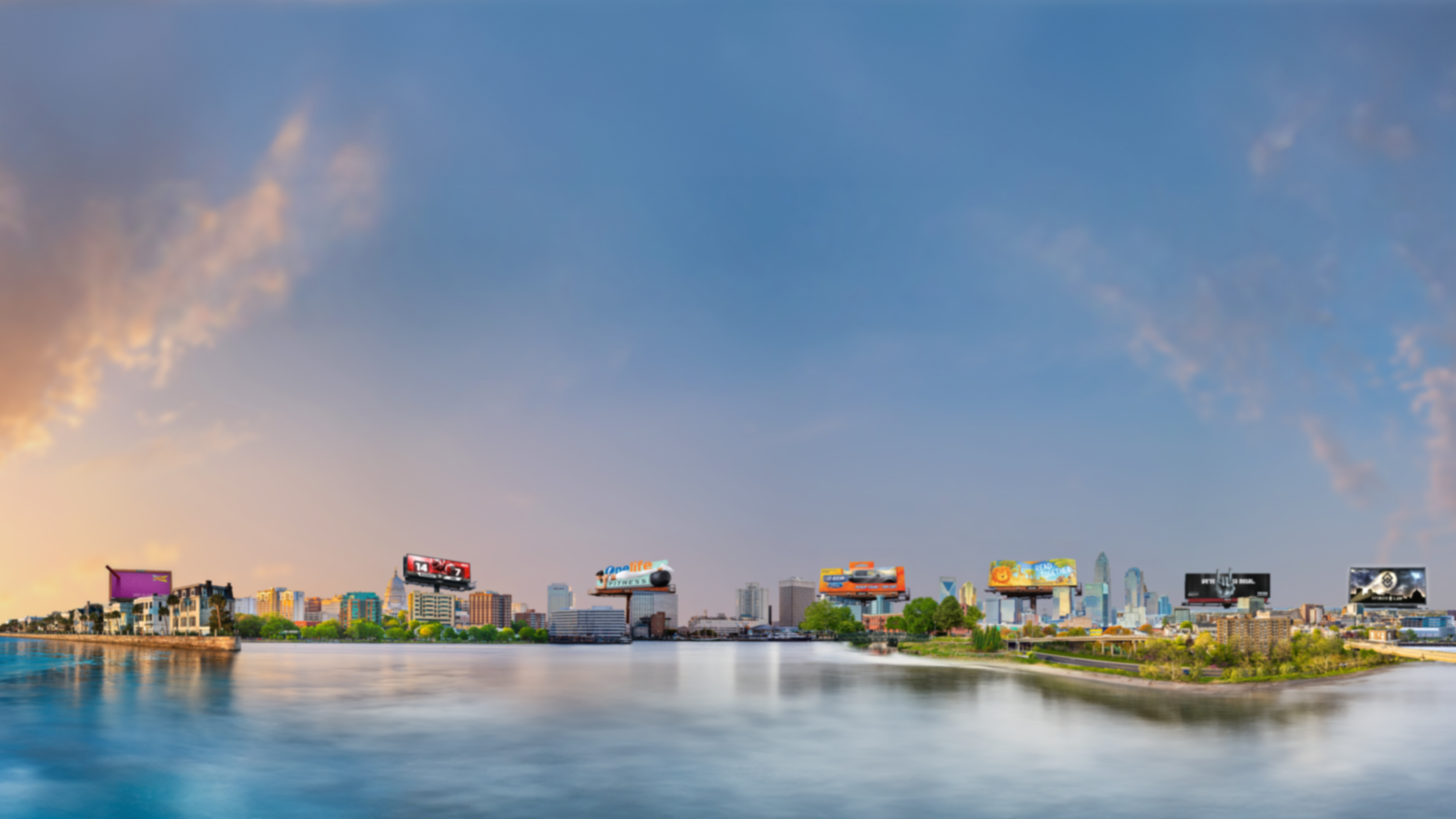
What Is Out of Home Advertising (OOH)? Types, Examples & Benefits
With so many formats, out of home advertising is nearly inescapable. Simply defined, out of home (OOH) advertising—also known as outdoor advertising—includes any advertising you encounter when you leave your home and go about your daily activities. From billboards to transit ads, OOH media is designed to reach consumers on the move.
Because these formats are placed along high-traffic routes and everyday environments, it’s no surprise that 88% of adults have noticed OOH advertising in the past 30 days.
Why Out of Home Advertising Is So Effective
The benefits of out of home advertising are many, and marketers are beginning to realize that OOH is foundational to their campaigns, not just a nice add-on. It is a full-funnel solution affecting all parts of the customer journey.
Marketers are increasingly recognizing that OOH advertising is not just a supplemental tactic—it’s a foundational part of the marketing mix.
OOH works across the full funnel, influencing:
- Awareness
- Consideration
- Action
Its ability to reach large audiences in the real world makes it one of the most powerful and trusted advertising channels available.
Benefits of Out of Home Advertising
Out of home advertising continues to grow because of its unique advantages:
- High visibility: Ads are placed in high-traffic areas where audiences naturally look
- Broad reach: Connects with diverse audiences, including younger and multicultural consumers
- Always on: Cannot be skipped, blocked, or turned off
- Hyper-local targeting: Delivers messaging based on geography and context
- Recency: Reaches consumers close to the point of purchase
- Measurable impact: Advances in data allow advertisers to track brand lift, foot traffic, and sales
Types of OOH Advertising
There are four primary categories of OOH advertising, each with multiple formats:

Billboards
Large-format advertising displays found along highways, major roads, and urban areas. Billboards are designed for maximum visibility and impact.
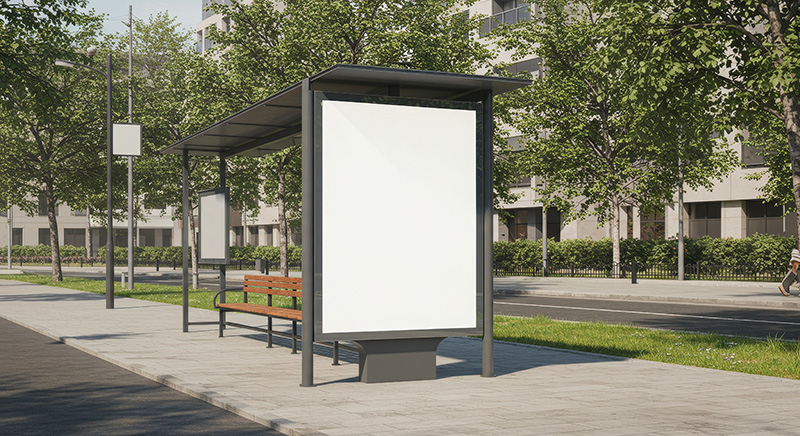
Street Furniture
Includes bus shelters, benches, kiosks, and other placements in pedestrian-heavy areas. These formats reach audiences at eye level.
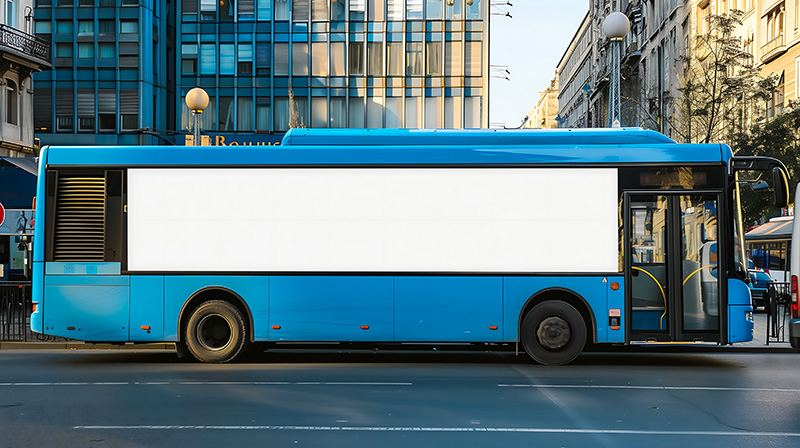
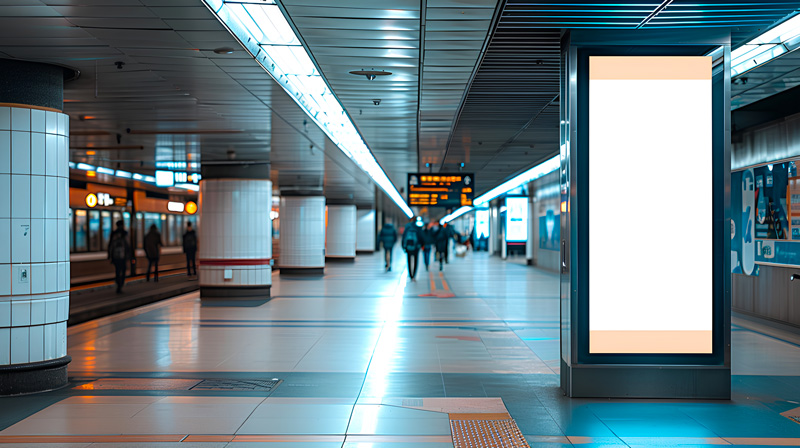
Transit
Ads placed on or inside public transportation vehicles and stations make up this OOH format. Subway station posters, bus wraps, and in-airport advertising are examples of transit ads.
Place-Based
These ads are targeted to specific locations such as malls, entertainment and sports venues, gyms, retail stores and restaurants. Ads are usually contextual to capitalize on the “captive” audience.
Examples of Out of Home Advertising
Common examples of OOH advertising include:
- Highway billboards
- Digital billboards
- Bus wraps and transit ads
- Airport advertising displays
- Mall and retail signage
- Gas station and convenience store screens
These formats work together to create consistent, high-frequency brand exposure.
Static vs. Digital Out of Home (DOOH)
Static (Traditional) OOH Advertising
Static OOH uses printed or painted materials, with one advertiser per display.
Advantages include:
- 100% share of voice
- Continuous exposure
- Strong long-term visibility
Considerations:
- Creative updates require printing and installation
- Weather and time can impact materials
Digital OOH (DOOH)
Digital out-of-home advertising (DOOH) uses digital screens to display rotating ads for multiple advertisers.
Benefits include:
- Instant creative updates
- No printing costs
- Flexible messaging and scheduling
DOOH can also be purchased programmatically through demand-side platforms (DSPs), allowing advertisers to:
- Target specific audiences
- Control budgets and timing
- Access large-scale inventory
Focus on Billboards
Billboards, the oldest, most visible out of home format, are still among the most effective and trusted advertising methods. There are three main categories of billboard:


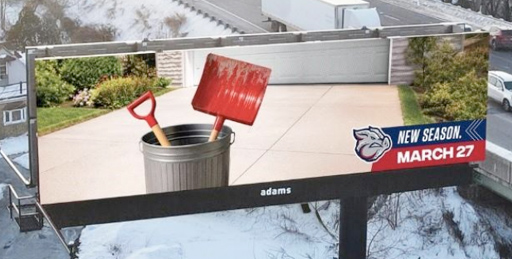
Static Bulletins
The “giants” of the billboard industry, bulletins are the largest and most impactful static billboard format, per the Outdoor Advertising Association of America. They come in two standard sizes: 14′ x 48′ and 10.6′ x 36′. Permanent static bulletins – messaging remains in a fixed location for an extended duration – are used to dominate high-traffic-volume areas. Rotary bulletins – messaging moves to different locations over the course of the contract – give broad market coverage and the illusion that a brand is “everywhere.” Often placed on highways, interstates and main city arteries, static bulletins are impossible to ignore.
Static Poster
Poster billboards are great for reaching hyper-local audiences where they live, work, play or shop. Smaller in size than bulletins, they measure 10′ 4.5″ x 22′ 7.5.” Posters are incorporated into neighborhoods, business districts, and commuter roadways. Poster billboards are often used for shorter-term campaigns. Individual posters may be used directionally, to point potential customers toward a business’ location. They are also used in groups for quickly scaling awareness of new products, limited-time sales, etc.
Digital Billboards
Digital billboards are found in high-impact locations, like heavily traveled arteries and secondary intersections where traffic moves slowly. Digital OOH units come in varying sizes. Each unit’s ads rotate every 8 seconds, meaning multiple advertisers can share one highly desired location. Each advertiser receives approximately 1,250 spots per day. At busy intersections, this can mean that vehicle occupants see 3-4 ads while waiting for a streetlight to change.
Because ads are delivered to the unit electronically, the cost and lead time needed for vinyl creative is eliminated. New ads can be uploaded almost instantaneously and changed as often as desired. Dynamic ads magnify the memorability of these ads, utilizing concepts such as:
- Weather triggers – creative changes tied to snow, heat, rain, etc.
- Dayparting – Ads that run at different times of the day. For example, a QSR may run contextually relevant offers during certain times of day, such as breakfast specials during morning commute time.
- Sports Scores – win attention and favorability by displaying the local team’s scores in real time
- Multiple Creative Messages – for example, a grocery store individually promoting the week’s specials or a realtor featuring the week’s open house offerings.
- RSS feeds – can be tied to auto inventory lists, urgent care clinic wait times, etc. to promote up-to-the-moment content
How OOH Fits Into the Marketing Funnel
OOH advertising supports every stage of the customer journey:
- Top of funnel: Builds awareness with broad reach
- Mid-funnel: Reinforces messaging and brand recall
- Bottom of funnel: Drives action near point of purchase
When paired with digital media, OOH significantly amplifies campaign performance.
Adams Outdoor Advertising are Experts in Billboard Advertising
Adams Outdoor Advertising has over 40 years’ worth of knowledge in the benefits of using billboards for OOH advertising, OOH advertising strategy, and OOH campaign planning. Each of our markets provide extensive local expertise, creative design capabilities, and strategic planning support, and can manage the process for you. Adams combines audience insights, location data, and creative execution to ensure your billboard campaigns are both memorable and measurable. Reach out today to see what out of home can do for your business!
Frequently Asked Questions
OOH advertising includes any advertising that reaches consumers when they are outside their homes, including billboards, transit ads, street furniture and place-based advertising.
Out of Home ads exist in the physical world and can’t be avoided, while digital or online advertising targets people online and can often be blocked using ad blockers. Out of home is a “one message to many” format because it reaches a high number of people simultaneously. Digital or online ads are a one-to-one medium, because in most cases, one person is being served the ad on their phone, tablet, or computer.
Multiple studies have shown that OOH increases awareness, brand recall, and purchase consideration. That effectiveness is even stronger when OOH is paired with digital media.
The price of a billboard depends on the size, the location, the traffic volume passing by the billboard, the duration for which the ad will run, and the format. Posters generally cost less than digital or bulletin boards. As a whole, the billboard industry has one of the lowest CPMs in all media.
Brands from across all industries. Some of the top-spending industries include financial, legal, and healthcare services and quick serve restaurants.
Measurement services such as Geopath use location data, traffic counts, mobile data, and visibility metrics to calculate estimated impressions, reach and frequency.
Bold visuals, minimal text, high contrast, and clear messaging are key. Viewers have just a few seconds to process the message, so simplicity is a necessity.
Optimal results usually take around 12 weeks, and brand-building campaigns should run longer. A campaign with great reach and a very strong call to action can achieve success in 6-8 weeks.
OOH can work for both. The hyper-local targeting of OOH can greatly benefit local and regional businesses, while national brands love OOH for its massive reach and scalability.
Depending on the goal of the campaign, metrics may include impressions, lift in website traffic, lift in foot traffic, lift in brand awareness, or other KPIs.